Variable G in General Relativity
Solving Dark Matter and the Yang-Mills Problem
A mathematical framework where Newton's constant varies.
Derives MOND, explains dark matter, and addresses the mass gap.
Testable prediction proposed for 2026.
SUMMARY 2026
Variable-G Theory:
One Equation, Four Open Problems
Modern physics relies on several independent frameworks. General Relativity describes gravity, dark matter is invoked to explain galactic dynamics, dark energy is introduced to account for cosmic acceleration, and the Yang–Mills mass-gap problem remains unsolved.This work explores the possibility that these phenomena emerge from a common mechanism: a gravitational coupling that depends on the surrounding distribution of matter and energy. In simple terms, the theory proposes that Newton's gravitational constant, G, varies with surrounding matter.
Potential Implications
1. Galactic Dynamics Without Dark Matter
Galaxy rotation curves may be explained using visible matter alone through the effects of a variable gravitational coupling.
2. Cosmic Acceleration Without Dark Energy
The observed acceleration of the Universe may arise naturally from spatial variations of the gravitational coupling.
3. A Possible Route Toward the Yang–Mills Mass Gap
Under the assumption of a gravitationally unified framework, the proposed theory generates a non-zero mass gap for pure Yang–Mills theory through the same underlying mechanism.
4. Experimental Testability
The theory predicts measurable variations of the effective gravitational constant under controlled laboratory conditions.
Why This Matters
If confirmed, this framework could provide a common explanation for several major open questions in modern physics. If contradicted by experiment, it can be falsified through direct measurements of the gravitational coupling. The theory was developed between 2018 and 2025. Experimental collaborations are welcome. For mathematical details, derivations, and supporting calculations, see the Technical Summary.
Technical Summary
Mathematical sketch
1. Surrounding Gravity from Varying G
From the Lagrangian of General Relativity in vacuum, accounting for equivalence between ad hoc energy distributions, we derive the four-vectors describing local space-time structure:

This yields a variable gravitational constant G. A good approximation in most cases is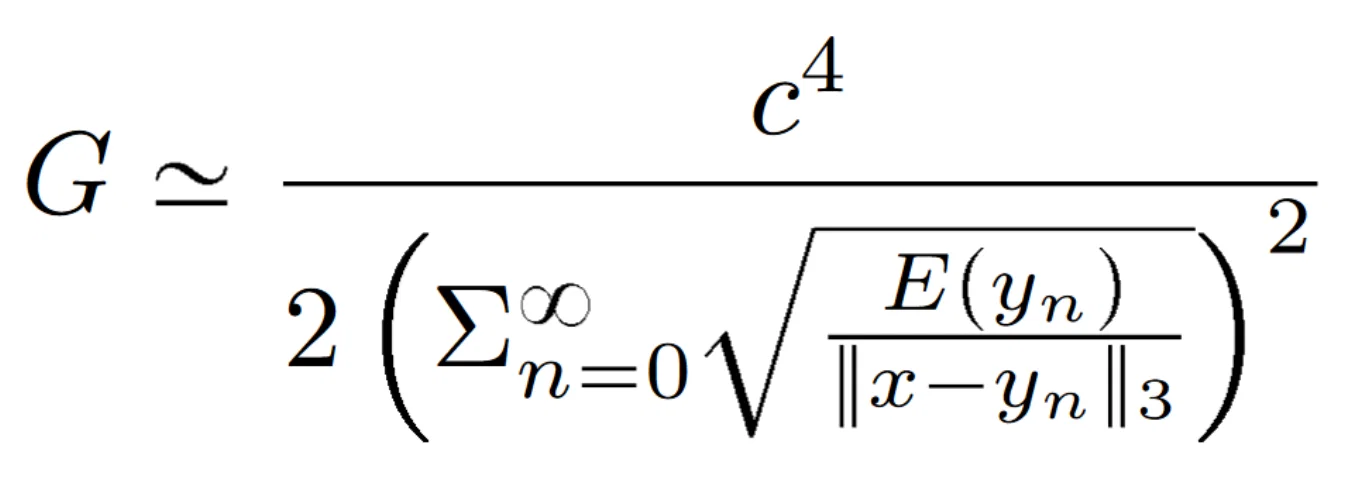
where E(yₙ) are surrounding energy distributions. This yields the "surrounding" effect, which gives 90% of the solutions to today's physics mysteries.
2. Dark Energy from Natural Cancellation
The cosmological constant is traditionally associated with a severe fine-tuning problem. In the Variable-G framework, no fine-tuning is required: under cosmological conditions, the attractive and surrounding terms appear in a ratio and become proportional, causing the mass dependence to cancel. A constant residual term then emerges naturally and acts as a cosmological constant.
3. Yang–Mills Mass Gap
The variable-G mechanism generates a mass gap Δm > 0 for pure Yang–Mills theory, satisfying the Clay Millennium criteria.
Empirical Tests
- Galaxy rotation curves: Predicted from baryonic mass alone
- CMB peaks: Fit without cold dark matter. In the early universe, the implied unified equations will have to reproduce standard general relativity with radiation and pressure and each equations of state must be retrieved also. The acoustic horizon and recombination physics are therefore unchanged, yielding a CMB spectrum identical to ΛCDM. No sterile neutrinos or new relativistic species added.
- Type Ia supernovae: Matches acceleration data
- Bullet Cluster: Explained by non-local G variation
- Ring galaxy: Stable configurations. No ad hoc galaxy encouters needed
- Faint dwarf galaxy: more systems predicted than with Newton's law
- Nuclear saturation: Consistent with variable-G nuclear potential
- Proton radius puzzle : Resolved by G(r) in bound states
Experimental Validation
Proposed test: Shielding measurement of G. A laboratory-scale measurement of G through dense matter should detect variations ΔG/G ~ 10⁻⁵ due to gravitational potential. Full experimental protocol available on request.
References
[1] Lassiaille, F. "Surrounding matter theory", EPJ Web of Conferences 182, 03006 (2018). https://doi.org/10.1051/epjconf/201818203006
[2] Lassiaille, F. "Relativity in Motion: Short Version", Proc. IWNT 39, p. 185 (2022). http://ntl.inrne.bas.bg/workshop/2022/contributions/p185_2022.pdf
[3] Lassiaille, F. "Relativity predicts a variable G", Full PDF (Apr 2025) — See at the top of this page
For additional mathematical derivations and extended calculations
See Extended Materials. Videos and social context are also available there.
Last updated: May 2026
Extended Materials


À propos

At the age of 24, I began exploring the idea that physics could be understood geometrically as a unified whole.
This led to an independent research program. An early version of this work was published in 2010. In 2015, these ideas inspired the development of the concept of "surrounding".
Between 2024 and 2025, the original framework was further refined, leading to the work Relativity Predicts a Variable G" and to a proposed solution to the "Yang–Mills mass-gap problem". The central claim is that several major open questions in modern physics may be addressed through an extension of General Relativity based on a variable gravitational coupling.
“In 2026, I presented a draft mathematical demonstration (available at the top of this page) showing that G naturally emerges as a variable quantity within the framework of General Relativity.
This led to an independent research program. An early version of this work was published in 2010. In 2015, these ideas inspired the development of the concept of "surrounding".
Between 2024 and 2025, the original framework was further refined, leading to the work Relativity Predicts a Variable G" and to a proposed solution to the "Yang–Mills mass-gap problem". The central claim is that several major open questions in modern physics may be addressed through an extension of General Relativity based on a variable gravitational coupling.
“In 2026, I presented a draft mathematical demonstration (available at the top of this page) showing that G naturally emerges as a variable quantity within the framework of General Relativity.