Technical Summary
Mathematical sketch
1. Surrounding Gravity from Varying G
From the Lagrangian of General Relativity in vacuum, accounting for equivalence between ad hoc energy distributions, we derive the four-vectors describing local space-time structure:

This yields a variable gravitational constant G. A good approximation in most cases is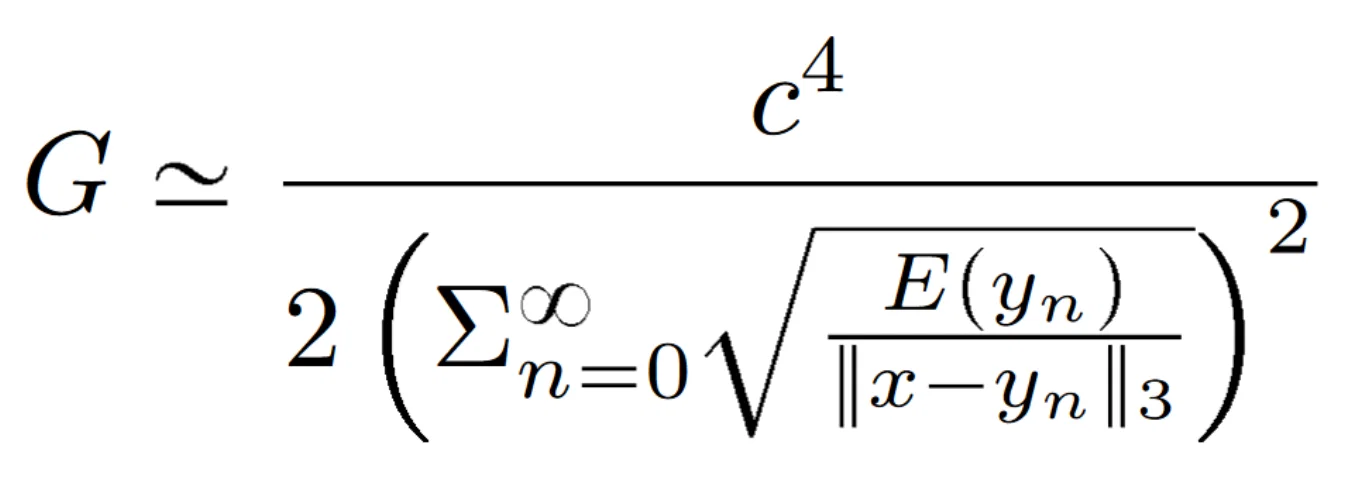
where E(yₙ) are surrounding energy distributions. This yields the "surrounding" effect, which gives 90% of the solutions to today's physics mysteries.
2. Dark Energy from Natural Cancellation
The cosmological constant is traditionally associated with a severe fine-tuning problem. In the Variable-G framework, no fine-tuning is required: under cosmological conditions, the attractive and surrounding terms appear in a ratio and become proportional, causing the mass dependence to cancel. A constant residual term then emerges naturally and acts as a cosmological constant.
3. Yang–Mills Mass Gap
The variable-G mechanism provides a direct and explicit solution to the Yang–Mills Millennium Problem as formulated by the Clay Mathematics Institute. By incorporating the missing chapter of General Relativity—the variable-G mechanism and its derived surrounding effect—the field equations naturally yield a strictly positive mass gap (Δ > 0) alongside a natural ultraviolet regularization of Feynman path integrals, resolving the gauge theory's foundational existence and mass gap requirements.
Empirical Tests
- Galaxy rotation curves: Predicted from baryonic mass alone
- CMB peaks: Fit without cold dark matter. In the early universe, the implied unified equations will have to reproduce standard general relativity with radiation and pressure and each equations of state must be retrieved also. The acoustic horizon and recombination physics are therefore unchanged, yielding a CMB spectrum identical to ΛCDM. No sterile neutrinos or new relativistic species added.
- Type Ia supernovae: Matches acceleration data
- Bullet Cluster: Explained by non-local G variation
- Ring galaxy: Stable configurations. No ad hoc galaxy encouters needed
- Faint dwarf galaxy: more systems predicted than with Newton's law
- Nuclear saturation: Consistent with variable-G nuclear potential
- Proton radius puzzle : Resolved by G(r) in bound states
Experimental Validation
Proposed test: Shielding measurement of G. A laboratory-scale measurement of G through dense matter should detect variations ΔG/G ~ 10⁻⁵ due to gravitational potential. Full experimental protocol available on request.
References
[1] Lassiaille, F. "Surrounding matter theory", EPJ Web of Conferences 182, 03006 (2018). https://doi.org/10.1051/epjconf/201818203006
[2] Lassiaille, F. "Relativity in Motion: Short Version", Proc. IWNT 39, p. 185 (2022). http://ntl.inrne.bas.bg/workshop/2022/contributions/p185_2022.pdf
[3] Lassiaille, F. "Relativity predicts a variable G", Full PDF (Apr 2025) — See at the top of this page
For additional mathematical derivations and extended calculations
See Extended Materials. Videos and social context are also available there.
Last updated: May 2026
